The children’s alleged influence by ghosts
The Turn of the ScrewThe children’s alleged influence by ghosts is the Governess’s increasingly elaborate account of why Miles and Flora seem at once exceptionally good and inaccessible to the adults around them. It gathers force from Mrs. Grose’s recollections of Miles’s intimacy with Peter Quint, the children’s persistent silence about their former companions, and the Governess’s conviction that the ghosts are closing a dangerous distance. Yet the account is never detached from the Governess’s point of view: the evidence and her interpretation arrive together, leaving the children’s supposed corruption bound to the story’s uncertainty about what she can truly know.
Background and Evidence
In a nocturnal conversation with Mrs. Grose, the Governess presses her to explain an earlier qualification about Miles’s character. During the weeks she herself has watched him, she insists, he has seemed an imperturbable prodigy of lovable goodness. Mrs. Grose’s exception reaches back to a period of several months when Miles and Quint were perpetually together. She had questioned the propriety of their close alliance, suggested that Quint’s relation to the boy was incongruous, and even approached Miss Jessel about it. Miss Jessel had sharply told her to mind her own business.
Mrs. Grose had also spoken directly to Miles, reminding him that young gentlemen should remember their station. The Governess interprets this as a reminder that Quint was a menial, and Mrs. Grose accepts that as a fair description. More troubling to her is Miles’s response: she was sure he had not denied being bad in some respect, but he did deny certain occasions. In particular, he prevaricated about going off with Quint and spending hours with him, at times as though Quint were his tutor and Miss Jessel merely the little lady. Mrs. Grose adds that Miss Jessel had not forbidden the association. The memories establish unusual closeness and evasion, but they do not independently establish the supernatural explanation the Governess builds upon them.
The Governess’s Interpretation
The Governess reads the children’s conduct as a deliberate pattern rather than a simple absence of disclosure. She argues that Miles and Flora never let slip an allusion to either of their former companions, just as Miles never mentions his expulsion from school. Their silence, in her account, is systematic; their sweetness and apparently absorbed play do not reassure her, but seem to conceal a separate life from which the adults are excluded.
She develops this suspicion into a theory of allegiance. The children, she declares, have not truly been good so much as absent from the life shared with their guardians: they belong, in her formulation, to Quint and Miss Jessel. She supposes that the ghosts want to reach them and continue the evil they had put into them during the earlier, worse period. When Mrs. Grose asks what the ghosts could now do, the Governess answers that they could destroy the children. That danger is her conclusion, not a fact independently confirmed by the narration.
Distance, Sight, and Danger
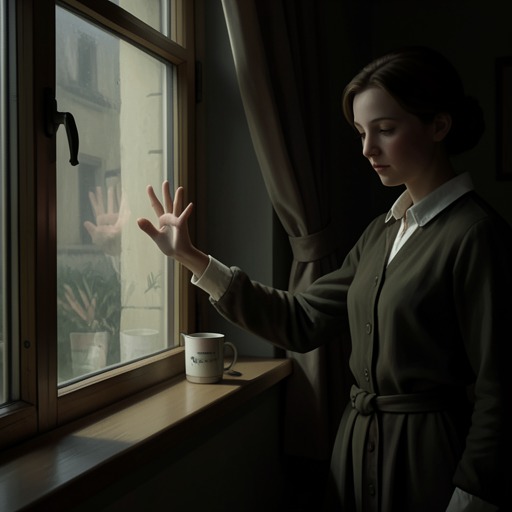
The Governess describes the apparitions as appearing at a distance: on towers and rooftops, outside windows, or beyond the edges of pools. In her reading, these separated, elevated, or far-side positions are not incidental sightings but signs of a design. The ghosts are trying to shorten the distance and overcome an obstacle; she fears that, given time and continued suggestions of danger, they may succeed in bringing the children within reach.
This spatial pattern gives her theory its urgent shape. The children’s alleged influence is not presented as a single visible transformation or confession; it is inferred from their silence, their closeness to the adults who are no longer present, and the recurring appearances at the margins of ordinary domestic space. The Governess turns separation into evidence of approach: what remains across a window, on a high place, or at the far edge of water may, she believes, be moving nearer.
The Apparent Plan and Its Limits
Later, when Mrs. Grose asks whether Miss Jessel is with Flora, the Governess answers with certainty that she is, and says they must find the child. She locates Miles with Quint in the schoolroom. She then interprets the children’s circumstances as a successful trick: Miles, she believes, has found a way to keep her quiet while Flora went away with Miss Jessel, and has thereby provided for himself as well.
The exchange shows how rapidly the Governess converts an uncertain situation into an account of coordinated action. Her calm confidence is striking to her, and even the word she first chooses to describe Miles’s arrangement—divine—turns immediately into its opposite, infernal. The reversal conveys her conviction that the children’s charm is a cover for danger. At the same time, the episode supplies her judgment rather than independent confirmation of the ghosts’ presence or the children’s intentions. Their alleged influence remains inseparable from the narrator’s increasingly forceful interpretation of silence, beauty, and distance.